

The rise of seven strings
You’re hearing it everywhere now—that low rumble and the weight of an extra string. It isn't just for extreme metal anymore. I see 7-strings showing up in mainstream rock and pop sessions more than ever. 2026 feels like the year it finally stops being a 'specialty' instrument and just becomes another tool in the rack.
The story doesn't begin today, though. Back in the 90s, guitarists like Steve Vai and Allan Holdsworth were among the first to explore extended-range instruments, pushing the boundaries of what was possible on the fretboard. Holdsworth, in particular, was a pioneer, using a custom-built 7-string to achieve his signature fluid legato style. These were early experiments, largely unknown to the average guitarist.
For years, the 7-string remained a tool for a select few. But the emergence of bands like Meshuggah in the late 90s and early 2000s changed everything. Their innovative use of polyrhythms and heavily downtuned 7-string guitars laid the foundation for the 'djent' movement, and with it, a massive surge in interest in extended-range instruments. The appeal is simple: more range means more notes, more possibilities, and a fuller, more powerful sound. It allows for complex chord voicings and riffs that are simply impossible on a standard 6-string.
Now, we’re seeing the influence of that early innovation spread. More and more guitar manufacturers are offering 7-string models, and a new generation of players are embracing the instrument. It’s not just about extreme metal anymore; the 7-string is finding its way into progressive rock, jazz fusion, and even pop music. The demand is there, and the industry is responding.
Tuning and string gauges
Okay, you’re intrigued by the 7-string. The first thing you need to figure out is how to tune it. Standard tuning (B E A D G B e) is a good starting point, offering a natural extension of the low E string. However, many players opt for lower tunings, like drop A (A E A D G B e), which is popular in djent and metalcore. Other common tunings include drop G# and even lower, depending on the desired sound.
Tuning significantly impacts string gauge. Going lower requires heavier strings to maintain tension and prevent floppiness. I’ve spent countless hours experimenting with different gauges, and I’ve found that a set of strings ranging from .009 to .064 is a good all-around choice for standard tuning. For drop A, I usually go with .010 to .070. But this is just a starting point. String gauge is a very personal preference, and it depends on your playing style and the scale length of your guitar.
Finding the right setup often involves trial and error. You might need to adjust your truss rod, intonation, and even your nut slots to accommodate the heavier strings. Don't be afraid to experiment and consult with a qualified guitar technician if you’re unsure. A properly set up 7-string will play much better and sound much more in tune.
- Standard tuning is B-E-A-D-G-B-E
- Drop A: A E A D G B e
- Drop G#: G# E A D G B e
Popular 7-String Guitar Tunings
| Tuning | Common Genres | String Gauge Recommendation | Pros | Cons |
|---|---|---|---|---|
| Standard (B E A D G B e) | Djent, Progressive Metal, Jazz Fusion | 10-56 or 11-58 | Offers a wider range without drastically altering familiar chord shapes. Versatile for various styles. | Can feel cramped for very low tunings; requires precise intonation. |
| Drop A (A E A D G B e) | Metalcore, Deathcore, Nu-Metal | 10-60 or 11-64 | Provides a heavy, powerful low end. Popular for aggressive rhythms and breakdowns. | Can be challenging for lead work in higher registers; string tension can be high. |
| Drop G# (G# E A D G B e) | Progressive Metal, Technical Death Metal | 10-60 or 11-64 | Offers an even lower range than Drop A, suited for very heavy styles. Allows for unique chord voicings. | Requires heavier gauge strings; may necessitate neck adjustments. |
| Drop F# (F# E A D G B e) | Extreme Metal, Djent | 11-68 or 12-70 | Extremely low tuning for very aggressive and atmospheric sounds. Provides a massive low-end presence. | Significant string tension; requires a well-setup guitar and strong fingers. |
| Extended Range (A# E B D G C# F#) | Progressive Rock, Experimental Metal | 10-56 or 11-60 | Offers a balanced range extension in both directions, useful for complex arrangements. | Less common, so finding resources and tutorials may be more difficult. |
| Drop C (C G C F A D# e) | Alternative Metal, Hard Rock | 10-56 or 11-58 | Provides a darker, heavier tone than standard tuning while remaining relatively accessible. | May require some adjustment for players accustomed to standard tuning. |
Illustrative comparison based on the article research brief. Verify current pricing, limits, and product details in the official docs before relying on it.
Beyond djent
It's impossible to talk about the 7-string’s rise without acknowledging the influence of djent. Bands like Meshuggah, Periphery, and Animals as Leaders were instrumental in popularizing the instrument and defining its sonic aesthetic. Their innovative use of polyrhythms, syncopation, and heavily distorted tones created a unique and instantly recognizable sound that captivated a generation of guitarists.
But the 7-string's influence extends far beyond djent. Progressive metal bands like Dream Theater and Opeth have incorporated the instrument into their complex and dynamic compositions. Deathcore bands like Whitechapel and Suicide Silence utilize the 7-string for its crushing low-end and aggressive tone. Even jazz fusion artists like Tosin Abasi (Animals as Leaders) have embraced the instrument’s versatility.
What’s fascinating is how the 7-string allows musicians to explore new harmonic and melodic territory. The extended range opens up possibilities for wider interval voicings, more complex chord progressions, and more expressive soloing. It’s not just about playing lower; it’s about creating a richer, more nuanced sound. Take Plini, for example. His incredibly melodic and atmospheric playing showcases the 7-string’s potential beyond aggressive riffing.
The instrument is becoming increasingly accepted across genres. The 7-string is no longer a novelty; it’s a legitimate musical tool that’s being used by a diverse range of artists to push the boundaries of their respective genres.
New techniques
The 7th string isn't just about adding a low B; it unlocks a whole new world of playing techniques. Extended-range chords become readily accessible, allowing you to create fuller, more complex harmonic textures. Instead of struggling to barre awkward chord shapes on a 6-string, you can often find a more comfortable and efficient voicing on a 7-string.
Wider interval voicings are another key benefit. The extra string allows you to stretch your chords and create more spacious, atmospheric sounds. This is particularly useful for creating ambient textures or adding a sense of grandeur to your compositions. Think about the possibilities for creating unique chord inversions and voicings that simply aren’t possible on a standard guitar.
The expanded melodic possibilities are also significant. You can now play melodies and runs that extend beyond the range of a 6-string, allowing for more expressive and dynamic solos. The extra string also provides more options for tapping and legato techniques. It encourages a different approach to the fretboard.
These techniques aren’t just for shredders. They can be applied to a wide range of playing styles, from fingerstyle acoustic to heavy metal riffing. The key is to experiment and find ways to incorporate the 7th string into your existing playing vocabulary.
- You can play wider interval voicings that aren't possible on a six-string.
- Wider interval voicings
- Expanded melodic possibilities
- New tapping and legato techniques
Guitars and pickups
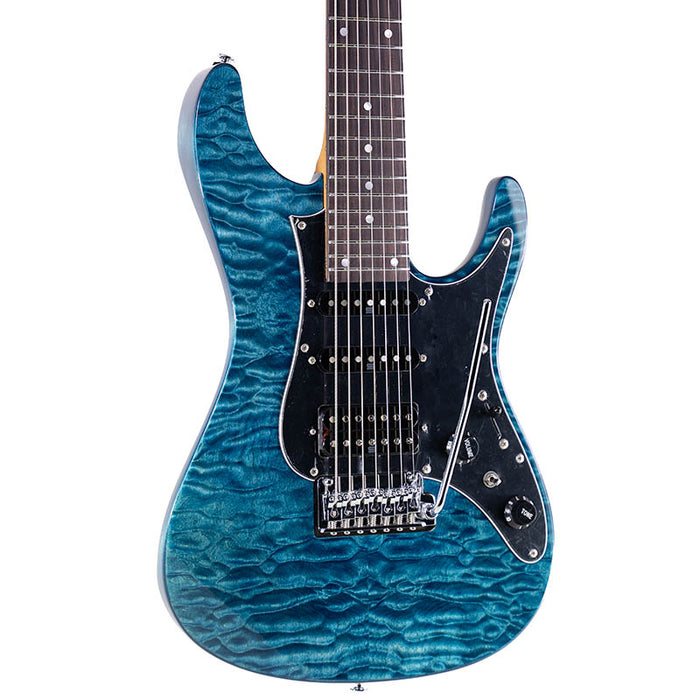
The 7-string market is growing, and there's a wider range of guitars available than ever before. Ibanez is a long-standing player in this space, with models like the RG7 and Universe series being popular choices. Schecter also offers a variety of 7-string guitars, catering to different styles and budgets. More recently, companies like Strandberg have gained recognition for their innovative headless designs.
Republic Guitars offers a range of instruments, including those with a focus on quality construction and sound (as seen on their website). While not exclusively 7-string focused, their commitment to craftsmanship suggests they could be a viable option for players seeking a unique instrument. Body wood, neck profile, and hardware all play a role in the overall feel and sound of the guitar. Mahogany typically provides a warm, resonant tone, while maple offers a brighter, more articulate sound.
Pickups are crucial. The low B string requires a pickup that can deliver a clear, powerful signal without getting muddy. High-output humbuckers are a popular choice, but active pickups can also provide excellent clarity and definition. Fishman Fluence, Bare Knuckle Pickups, and Lundgren are all well-respected brands that offer high-quality 7-string pickups.
Don’t get caught up in brand wars. Focus on finding a pickup that complements your playing style and the type of music you play. Consider the magnetic pull of the pickup and how it affects the sustain and intonation of the low B string. A well-chosen pickup can make a huge difference in the overall sound of your 7-string.
Amps and signal chains
Standard guitar amps often choke on a low B. They aren't designed to push those frequencies, so you end up with a flubby mess. I usually suggest using a high-headroom tube head or moving toward full-range cabinets that can handle the extra excursion without farting out.
Impulse responses (IRs) and digital modeling have become increasingly popular for achieving a tight and defined 7-string tone. IRs capture the sonic characteristics of a specific speaker cabinet and allow you to recreate that sound digitally. Digital modeling amps, like those from Kemper and Fractal Audio, offer a wide range of amp models and cabinet simulations.
My personal preference is to use a combination of a tube amplifier and an IR loader. I find that the tube amp provides warmth and dynamics, while the IR loader allows me to fine-tune the cabinet response. I typically use a scooped mid-range EQ setting to emphasize the low end and a touch of compression to tighten up the sound. A noise gate is also essential for eliminating unwanted hum and noise.
Experiment with different effects pedals to create your own signature tone. Octave pedals can add depth and texture, while delay and reverb can create atmospheric soundscapes. Don't be afraid to push the boundaries and explore unconventional effects combinations.
Ohhhh yeah xD Like I get the reason for 8 or 9-string/extended range guitars, but holy crap- I think 9 might be a bit much xD Then again my favorite band Chelsea Grin uses an 8-string at times, sooo, I might be a tad bias-
— Copacetic_ZX2 (@Copacetic_ZX2) May 3, 2026

No comments yet. Be the first to share your thoughts!