

The 7-String Surge: A New Standard?
The guitar world is changing. Extended range instruments, especially 7-string guitars, are moving from a niche interest to a mainstream option for players across genres. Guitarists now expect more from their instruments.
Historically, the 7-string was pioneered by players like Steve Vai, who explored its possibilities back in the 1990s. Tosin Abasi of Animals as Leaders really cemented its place in the modern progressive metal scene. But now, in 2026, the 7-string isn’t just for those at the extreme edge of technical playing. It’s a tool that’s finding its way into the hands of a wider range of musicians.
This isn't just about adding a string; it's about unlocking new sonic territories and compositional possibilities. The expanded range offers deeper bass response, more complex chord voicings, and a wider palette for creative expression. The 7-string is solidifying its position as a legitimate and versatile instrument.
Increased visibility in popular music and advancements in guitar technology are driving this surge. Extended range guitars are integrating into the mainstream, not just being experimented with.
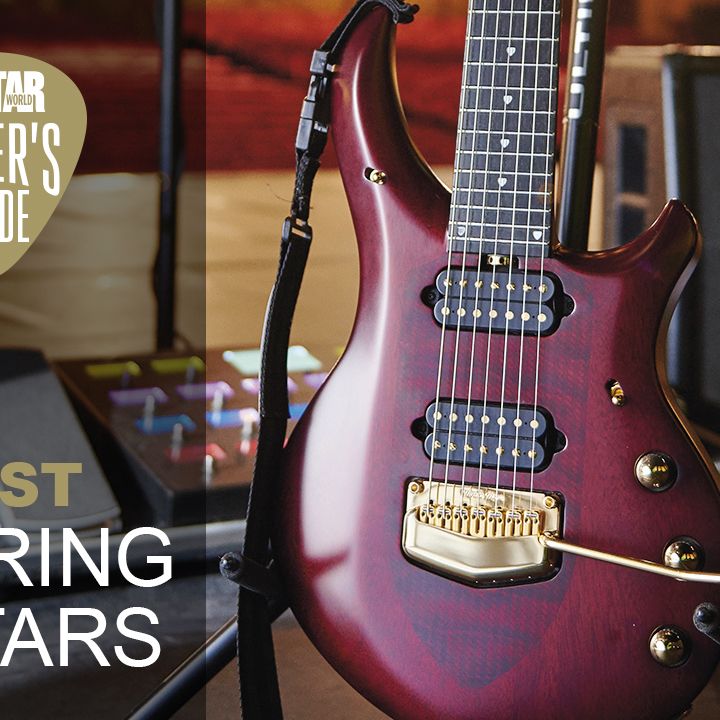
Genre Shifts Driving Demand
Demand for 7-string guitars is largely driven by progressive metal and its offshoots. Bands in these genres require the extended range for their signature sounds. Lower tunings and complex arrangements are difficult or less effective on a standard 6-string.
Djent, a subgenre of progressive metal characterized by heavily distorted, palm-muted riffs, is a prime example. Bands like Meshuggah practically invented the sound, and the 7-string is integral to their polyrhythmic and low-tuned approach. Periphery, another influential act, consistently pushes the boundaries of technical proficiency and compositional complexity, and their reliance on 7-string guitars is well-documented.
Animals as Leaders, with Tosin Abasi at the helm, have been instrumental in popularizing the 7-string. Their music demonstrates the instrument’s versatility, showcasing both its technical capabilities and its potential for melodic expression. These artists aren't just playing fast; they’re crafting intricate musical landscapes that demand the extended range.
The 7-string allows composers to explore harmonic and melodic ideas difficult or impossible on a 6-string. The added low B string provides a foundation for heavy sounds, while higher strings offer clarity and articulation, leading to more dynamic range and compositional freedom.
Beyond Metal: Expanding Horizons
While 7-string guitars are rooted in metal, their application is expanding. Musicians in other genres are discovering the sonic possibilities of the extended range.
Jazz fusion is one area where the 7-string is gaining traction. Guitarists are using the extended range to create richer, more complex chord voicings and to explore new harmonic territories. The added string allows for more sophisticated arrangements and a wider dynamic range, which is crucial for this genre.
Progressive rock, with its emphasis on experimentation and technical prowess, is another natural fit. Bands use the instrument to create layered textures and push the boundaries of traditional rock instrumentation. Some players even incorporate 7-strings into more traditional progressive arrangements.
Some experimentation with 7-string guitars is happening in pop and hip-hop. While rare, producers and artists use the instrument for unique textures and low-end frequencies. It's unclear if these genres will fully adopt the 7-string, but exploration is underway.
7 String Metal
This playlist is an excellent resource for showcasing the power and prevalence of 7-string guitars in modern music, particularly within the metal genre, aligning perfectly with the article's focus on their dominance.
Construction & Tech: Multi-Scale and Fans
Making a 7-string guitar playable and comfortable requires clever engineering. Simply adding a string to a standard 6-string design creates intonation problems and playability issues due to increased string tension and altered scale length. Innovations like multi-scale (fanned fret) designs address these challenges.
Multi-scale guitars have a fretboard where scale length is longer on lower strings and shorter on higher strings. This optimizes string tension, improving intonation, clarity, and playability.
Common body woods include mahogany, alder, and ash, each with distinct tonal characteristics. Neck woods like maple and walnut offer stability and resonance. Pickup configurations vary, with humbuckers providing high output and single-coils offering brighter tones.
7-string guitars use reinforced necks, through-body construction, and carefully chosen hardware to manage the added tension. The goal is an instrument that withstands the stress of the extra string while maintaining playability and tonal quality.
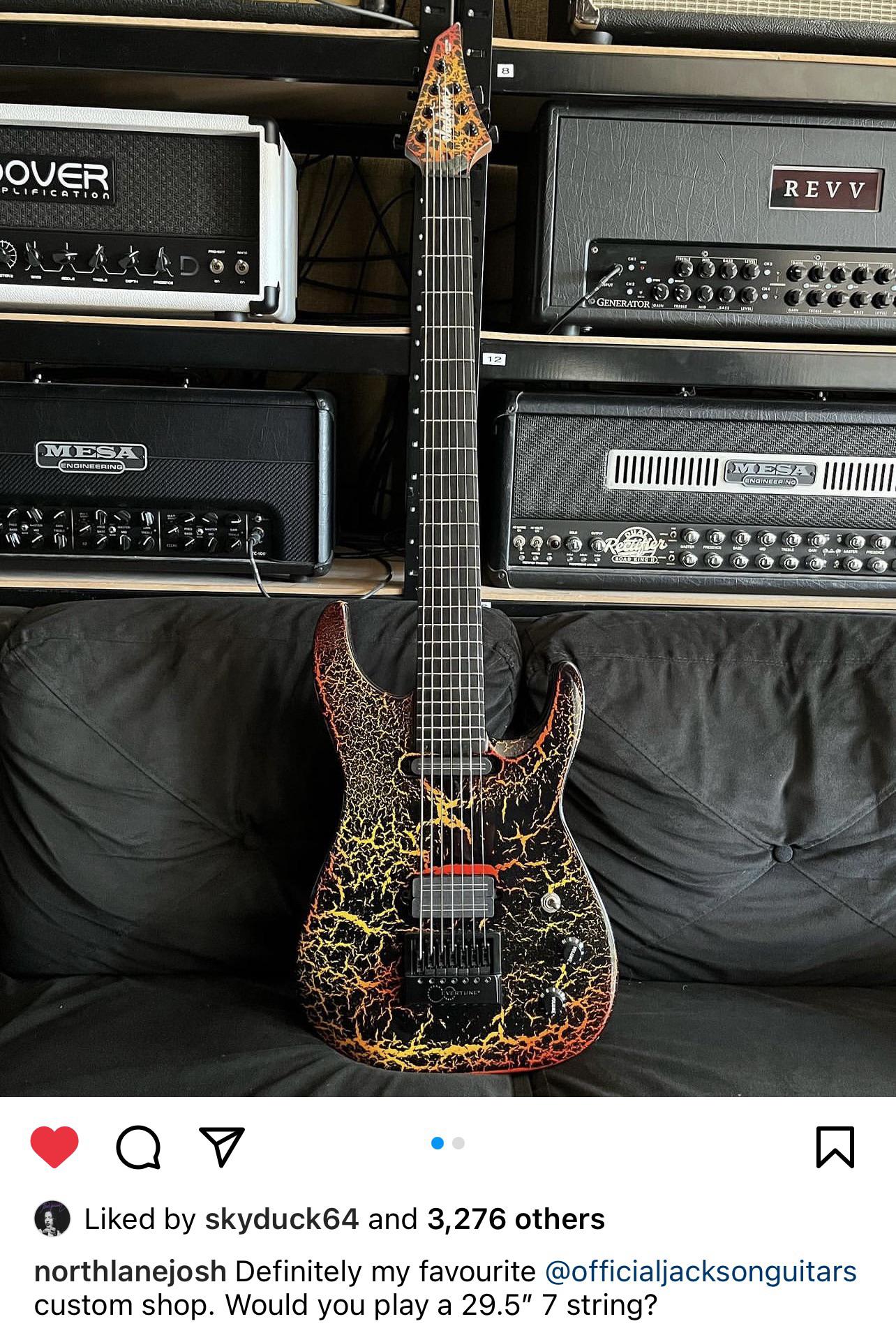
Tuning Options: Finding Your Voice
Choosing the right tuning maximizes a 7-string guitar's potential. Standard B tuning (B-E-A-D-G-B-E) offers a full octave and allows for deep riffs, but it's not the only option.
A-tuning (A-E-A-D-G-B-E) is another popular choice, particularly among djent and progressive metal players. It offers an even lower range and a heavier sound, but can require heavier gauge strings to maintain proper tension. Drop A tuning (A-E-A-D-G-B-E with the low B tuned down to A) is also frequently used.
Lower tunings offer more low-end power but can feel slacker and harder to bend. Higher tunings provide more clarity and articulation but may lack sonic weight. Experimentation is key to finding what works for your style.
Create custom tunings to achieve specific sounds. Online resources and communities offer inspiration and guidance for 7-string tuning.
Popular 7-String Guitar Tunings
| Tuning Name | String Gauges Recommended | Common Genres | Pros | Cons |
|---|---|---|---|---|
| Standard B | 10-46 or 10-52 | Metal, Djent, Progressive Rock | Extended low end, familiar interval relationships for those used to standard tuning | Can require heavier strings, potentially more tension on the neck |
| Drop A | 10-56 or 11-56 | Metalcore, Death Metal, Nu-Metal | Very popular for aggressive styles, easy power chord shapes | Lower range may become muddy with some pickups/amplifiers |
| Drop G# | 9-54 or 10-56 | Progressive Metal, Experimental Rock | Offers a unique tonal palette, good for complex arrangements | Requires adjustment for players accustomed to more common tunings |
| A Standard | 9-54 or 10-56 | Jazz Fusion, Progressive Rock, Ambient | Wider tonal range, allows for interesting chord voicings | Can be challenging to adapt to if coming from standard tuning |
| Drop F# | 11-58 or 12-60 | Extreme Metal, Djent | Extremely low tuning, ideal for very heavy riffs | High string tension, requires a well-setup guitar and strong fingers |
| Extended Range (C# Standard) | 9-56 or 10-60 | Modern Progressive, Instrumental | Provides a broad range for melodic and harmonic complexity | Requires familiarity with wider fretboard spacing |
Illustrative comparison based on the article research brief. Verify current pricing, limits, and product details in the official docs before relying on it.
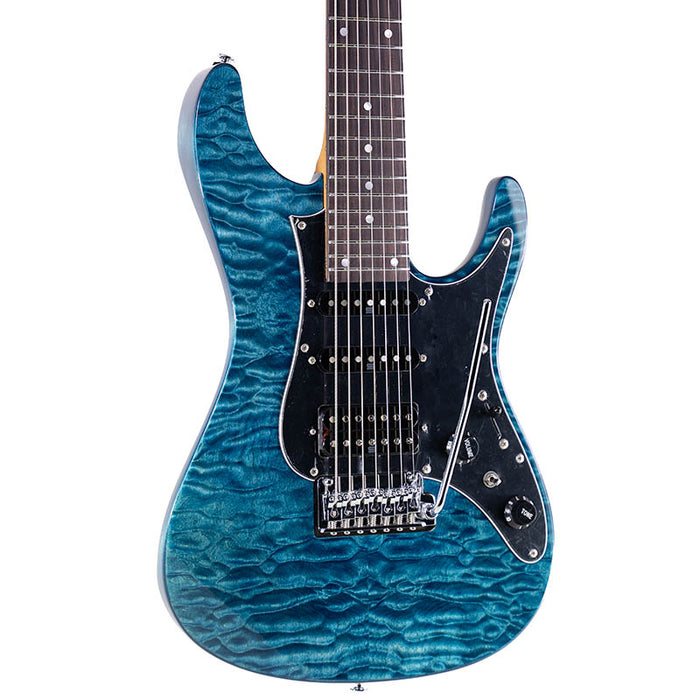
Gear Spotlight: Top 7-String Models (2026)
The 7-string market is booming, offering a fantastic selection of instruments. Here are a few standout models, covering a range of price points and features.
Ibanech RG7421PB: A classic choice for metal players, the RG7421PB offers a fast neck, powerful pickups, and a comfortable body contour. It's a workhorse instrument that's built for speed and aggression. Price range: $999 - $1299.
Schecter C-7 Hellraiser FR: Known for its aggressive aesthetic and high-output pickups, the C-7 Hellraiser FR is a popular choice among djent and progressive metal guitarists. It features a Floyd Rose tremolo system for dive bombs and other expressive techniques. Price range: $1199 - $1499.
Kiesel Set Neck 7: Kiesel offers a high degree of customization, allowing you to build a 7-string to your exact specifications. Their set-neck models are known for their exceptional sustain and tonal clarity. Price range: $1800+
Strandberg Boden 7: Strandberg guitars are renowned for their lightweight design, ergonomic comfort, and innovative features. The Boden 7 is a premium instrument that's favored by professional musicians. Price range: $2500+
These are just a few examples, of course. Other notable brands include Mayones, Aristides, and Jackson. The best 7-string for you will depend on your individual needs and preferences.
Technique Deep Dive: New Skills Needed?
Playing a 7-string guitar requires adapting fundamental techniques to exploit the instrument's extended range. It's about more than just learning more notes; it's about accommodating the extra string.
Sweep picking, a technique used to play arpeggios quickly and efficiently, is particularly well-suited to the 7-string. The wider fretboard allows for more complex and expansive sweeps. Tapping, another popular technique, also benefits from the added string, allowing for more intricate and melodic patterns.
Legato, the technique of smoothly connecting notes, is essential for achieving a fluid and expressive sound on the 7-string. The added string provides more options for creating seamless transitions between notes. Chord voicings are also fundamentally different. The extra string opens up a world of new harmonic possibilities.
Developing these skills takes time and dedication. Start with simple exercises and gradually increase the complexity as you improve. There are plenty of online resources and instructional videos available to help you along the way. Don’t be afraid to experiment and find what works best for you.
The Future of Extended Range
The trend toward extended range guitars shows no signs of slowing down. As musicians continue to push the boundaries of musical expression, we can expect to see even more innovation in this space. I believe we’ll see refinements in existing technologies, as well as the emergence of entirely new ones.
Pickups are a key area for potential development. Manufacturers are constantly experimenting with new designs and materials to create pickups that can better capture the nuances of the extended range. Software-based modeling and effects are also becoming increasingly sophisticated, allowing guitarists to shape their sound in unprecedented ways.
We might also see more experimentation with alternative construction methods. Lighter, more resonant body woods, as well as innovative neck designs, could further enhance the playability and tonal characteristics of extended range guitars. Guitars Republic has highlighted the growing emphasis on sustainable manufacturing, and this will undoubtedly influence the future of guitar construction.
The possibility of 8-string, 9-string, and even more extreme guitars becoming more common is also on the horizon. While these instruments may remain niche for now, they represent the ultimate expression of the extended range concept. It’s an exciting time to be a guitarist.
7-String #Guitar #Tips and #Tricks! | #Gear #GODS
— Just The Tone (@JustTheTone) April 5, 2023
> https://t.co/ejNMzMwRnc
#7String #7StringGuitar #7String #8string #ExtendedRange #GearGods #GearReview #Geargods #HeavyMetal #IsaacStolzergary #Lesson #Metal #Multiscale #MusicGear #PaulReedSmith #PRS #PRSGuitars #PrsSe pic.twitter.com/sESdddTJGN

No comments yet. Be the first to share your thoughts!